
Ontario soil and planting guide
Can You Plant Emerald Cedars in Clay Soil in Ontario?
Yes, sometimes. Emerald Cedars can establish in clay-rich soil if water drains well enough for roots to breathe. The problem is not clay alone. It is waterlogged soil, compaction, incorrect planting depth and uneven watering.
Updated November 3, 2026 · Ontario and Greater Toronto Area · Approx. 7 minute read
Why heavy clay creates planting problems
Clay particles are small and hold water well. That can be useful during summer dry spells, but compacted clay often drains slowly. Cedar roots need both moisture and oxygen. When a planting hole holds water for too long, roots can decline and foliage may brown. A tree can also dry out in a clay bed if water runs off a crusted surface instead of soaking into the root zone.
Read our guide to cedar browning to distinguish drainage stress from drought, salt and winter damage.
Simple drainage checks before ordering cedars
- Look after heavy rain. Note standing water, soggy patches, downspout discharge and areas that stay wet for days.
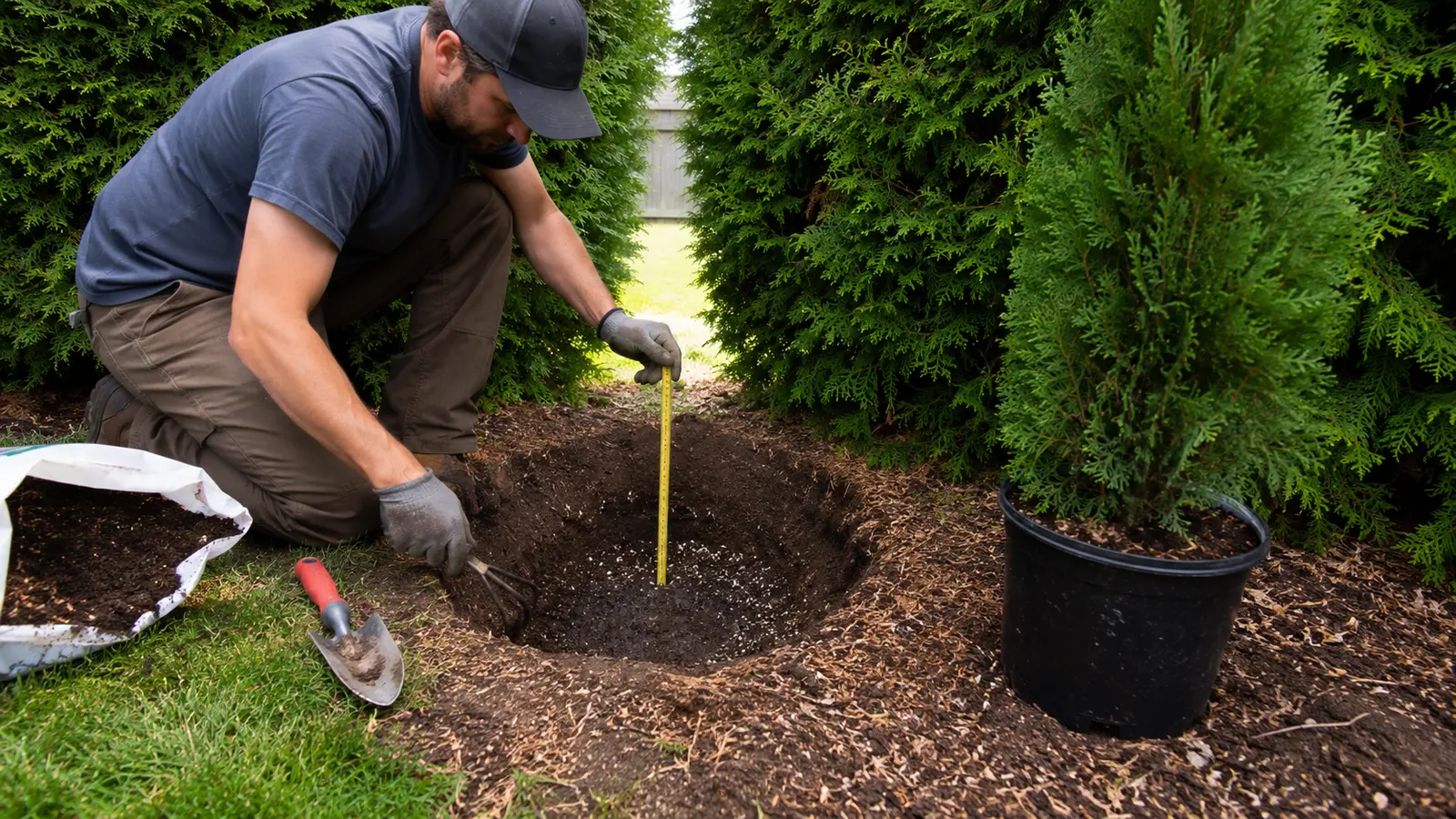
- Inspect the soil. Dig a small test hole where safe after checking for buried utilities. Observe whether the walls are heavily compacted and whether water collects.
- Perform a cautious infiltration test. Fill a test hole with water, allow the first fill to soak in, refill and note drainage. A hole that stays full for many hours or into the next day is a warning, not a precise diagnosis.
- Compare along the hedge line. Slopes, downspouts and former construction areas can make drainage vary dramatically across the same property.
- Get site-specific advice for persistent waterlogging. A raised planting area or engineered drainage may be needed, and some sites are unsuitable for Emerald Cedars.
How to plant Emerald Cedars in workable clay soil
- Choose the right location. Prioritize adequate sunlight, access to water, and soil that drains between irrigation events. Our sunlight guide explains the tradeoffs.
- Plant at the correct depth. Identify the root flare and keep it at or slightly above the surrounding grade as appropriate for the site. Do not bury the trunk or root crown.
- Make a wide, shallow planting area. Loosen the surrounding soil carefully without creating a deep bowl filled with rich, sharply different backfill.
- Backfill mainly with native soil. Avoid a highly amended pocket that traps roots and moisture at the clay boundary. Broad soil improvement may be appropriate after local assessment.
- Mulch without piling against the trunk. A shallow organic mulch layer helps moderate moisture while leaving the root flare visible.
- Water based on soil moisture. Feel soil near the root ball and surrounding clay before irrigating. See our cedar watering instructions.
Mistakes that cause newly planted cedars to fail
- Digging too deeply and burying the root flare.
- Installing a gravel layer in the bottom of the planting hole as a supposed drainage fix.
- Overwatering on a fixed schedule without checking moisture.
- Planting in a low area that receives roof runoff or winter road salt.
- Planting a hedge too close to fences for future maintenance or adequate airflow.
- Assuming browning always means the tree needs more water.
What if the site stays wet?
Do not install a row of Emerald Cedars in persistently saturated clay without correcting the problem. A landscape professional can assess grading, drainage routes, raised beds and species alternatives. The Ontario privacy tree comparison helps shortlist alternatives, although every tree still needs appropriate root-zone conditions.
For hedge length and tree counts, use the privacy hedge calculator, then check NorthCedar pricing before requesting a site-specific quote.
Frequently asked questions
Can Emerald Cedars survive in clay soil?
Yes, if the site drains adequately and roots receive oxygen. Heavy clay that stays saturated is a serious risk. A site assessment matters more than simply adding compost.
Should I put gravel at the bottom of a cedar planting hole?
No. A gravel layer under a finer-textured planting mix can create an abrupt soil boundary and does not reliably solve drainage problems.
Should I add sand to clay when planting cedars?
Small amounts of sand are unlikely to improve heavy clay and can create an inconsistent soil mix. Improve overall site drainage and soil structure rather than trying to fix a single planting hole.
How often should newly planted cedars be watered in clay?
Water according to actual root-zone moisture, recent rain, temperature and drainage. Check soil several centimetres down before watering, and avoid saturating waterlogged clay.
This guide offers general landscaping education for Ontario homeowners. Site drainage, utility locations, tree condition and municipal rules should be checked before excavation or planting.