
Ontario backyard planning guide
Best Trees for Backyard Privacy in Ontario: 7 Options Compared
For most compact GTA yards, Emerald Cedar is a strong privacy hedge choice when there is adequate light, drainage and watering. But larger, shadier, windier or drier properties may call for a different evergreen. Compare seven options below before buying.
Updated November 3, 2026 · Ontario and Greater Toronto Area · Approx. 9 minute read
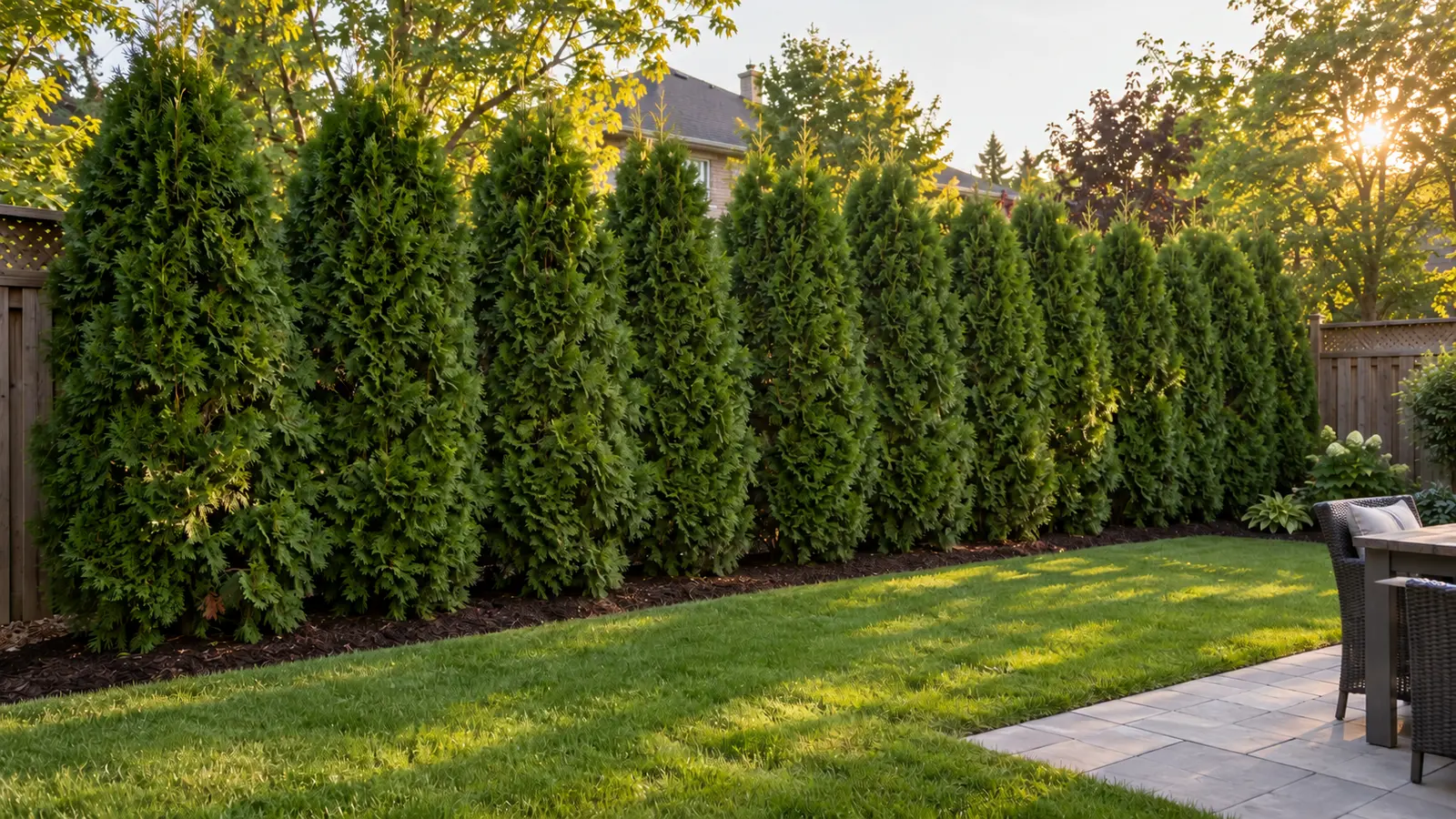
Illustrative NorthCedar privacy hedge image. Mature size and performance depend on cultivar and site.
Quick answer: which privacy tree should you pick?
Choose Emerald Cedar for a narrow, orderly fence-line screen with good drainage. Choose Eastern White Cedar for a more natural Ontario native hedge. Choose spruce only when you have substantial width. Consider yew or hemlock for certain sheltered, partially shaded sites. Green Giant needs especially careful checks of mature width and local winter hardiness.
Seven privacy trees compared
| Tree | Best use | Space needed | Light |
|---|---|---|---|
| Emerald Cedar | Narrow, formal evergreen hedges | Narrow to moderate | Sun to partial shade |
| Eastern White Cedar | Native, naturalistic cedar screening | Moderate | Sun to partial shade |
| Green Giant Arborvitae | Spacious, sheltered yards with room for large trees | Wide | Sun to partial shade |
| Norway Spruce | Large properties needing tall evergreen screening | Very wide | Mostly sun |
| Eastern Red Cedar | Sunny, dry or exposed sites with enough room | Moderate to wide | Full sun |
| Canadian Hemlock | Shadier, sheltered gardens | Moderate to wide | Partial shade |
| Yew | Clipped hedges in partial shade | Moderate | Part sun to shade |
These original illustrations show each tree type as a possible screening design. They are visual concepts, not photographs or scale-accurate botanical identification. Check nursery labels and the mature width of the exact cultivar you purchase.

1. Emerald Cedar
Narrow, formal evergreen hedges

2. Eastern White Cedar
Native, naturalistic cedar screening

3. Green Giant Arborvitae
Spacious, sheltered yards with room for large trees

4. Norway Spruce
Large properties needing tall evergreen screening

5. Eastern Red Cedar
Sunny, dry or exposed sites with enough room

6. Canadian Hemlock
Shadier, sheltered gardens

7. Yew
Clipped hedges in partial shade
1. Emerald Cedar
Thuja occidentalis ‘Smaragd’
A compact columnar cedar suitable for many GTA side yards. Individual trees form an attractive screen but may retain gaps while establishing.
Best for: Narrow, formal evergreen hedges
Important limitation: Needs reliable moisture and drainage; not suitable for wet roots.
Read related NorthCedar guide2. Eastern White Cedar
Thuja occidentalis
Ontario native evergreen commonly used in shelterbelts and hedges. Often broader and less uniform than an Emerald Cedar cultivar.
Best for: Native, naturalistic cedar screening
Important limitation: Can be browsed heavily by deer and needs shaping for a formal line.
Read related NorthCedar guide3. Green Giant Arborvitae
Thuja ‘Green Giant’
A vigorous, large-growing arborvitae that can overwhelm compact Toronto lots. Nursery hardiness claims vary, so confirm the planting location and wind exposure before buying.
Best for: Spacious, sheltered yards with room for large trees
Important limitation: Cold exposure and site hardiness must be checked locally; not a universal Ontario choice.
Read related NorthCedar guide4. Norway Spruce
Picea abies
A tall, dense evergreen appropriate for acreage and broad planting strips rather than a narrow townhouse boundary.
Best for: Large properties needing tall evergreen screening
Important limitation: Wide mature crown; unsuitable directly beside most urban fences.
Read related NorthCedar guide5. Eastern Red Cedar
Juniperus virginiana
Despite the name, this is a juniper. Its tolerance for sun and drier soil can suit difficult locations after establishment.
Best for: Sunny, dry or exposed sites with enough room
Important limitation: Form and density vary; avoid poorly drained sites.
Read related NorthCedar guide6. Canadian Hemlock
Tsuga canadensis
A soft-textured native evergreen that can be sheared as a hedge, but requires a cool, moist, well-drained and protected site.
Best for: Shadier, sheltered gardens
Important limitation: Drought, salt, wind and hemlock woolly adelgid are concerns.
Read related NorthCedar guide7. Yew
Taxus × media and suitable Taxus cultivars
Dense and tolerant of shaping. Select a cultivar hardy for the exact Ontario location and plant only in well-drained soil.
Best for: Clipped hedges in partial shade
Important limitation: Yew foliage and seeds are poisonous if eaten; avoid accessible areas for pets or children.
Read related NorthCedar guideHow to choose the right tree for your Toronto backyard
- Measure the available width. Allow room for mature branches, air movement, fence maintenance and access. A wide spruce is not a substitute for a slim cedar hedge.
- Check light throughout the day. Deep shade, especially beneath mature maples, can reduce hedge density. See our shade guide.
- Test drainage. Water that remains in a planting hole can damage roots even when the tree tolerates some soil moisture. See our clay soil guide.
- Check Ontario winter exposure. Regional conditions differ; salt spray, deer, wind and hardiness vary between Toronto and colder inland locations.
- Plan a realistic budget. Tall trees give earlier screening but need more money and careful establishment. Compare planting costs and the tree quantity calculator.
Frequently asked questions
What is the best tree for backyard privacy in Ontario?
Emerald Cedar is a practical starting point for many sunny GTA yards with a narrow planting strip. Wider lots may suit white cedar or spruce; shaded sites may suit a carefully selected hemlock or yew.
Which privacy tree grows fastest in Ontario?
There is no single fastest choice for every site. Green Giant can grow vigorously on suitable sheltered sites, but it becomes large and may not be hardy enough for exposed or colder Ontario locations.
Are evergreen trees better than deciduous trees for privacy?
Evergreens generally provide screening through winter. Deciduous trees can provide excellent seasonal shade and privacy but lose most leaves in autumn.
How many Emerald Cedars do I need for a privacy hedge?
Measure usable hedge length and choose spacing suited to the nursery stock and desired mature width. Use NorthCedar’s cedar hedge calculator to estimate quantity before ordering.
Planning note: Nursery labels, mature widths, cultivar hardiness and local planting rules should be verified for your specific property. Underground utilities should be located before digging. This guide is educational, not an on-site assessment.